
Vibe Coding in 2026: The $4.7B Trend That's Letting Non-Coders Ship Real Products
63% of vibe coding users aren't developers. The $4.7B market is growing 38% annually. Here's what vibe coding actually is, the best tools, and how solo founders are using it to go from idea to revenue.
OPC Community
Community Team
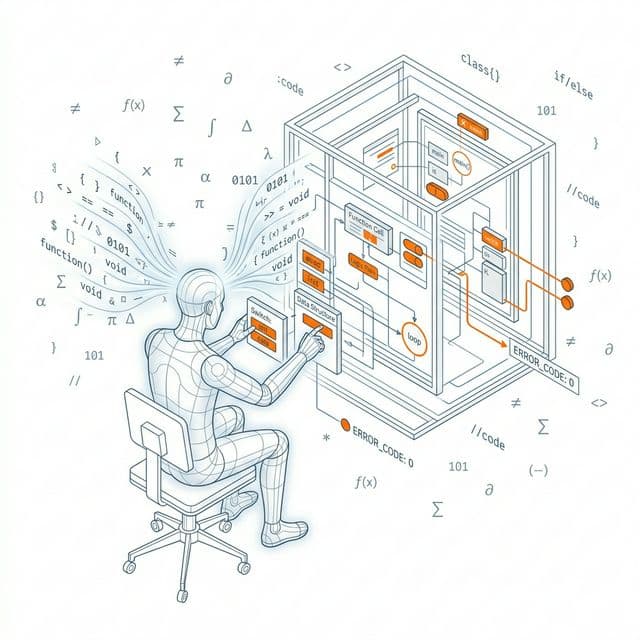
In early 2025, Andrej Karpathy — former AI Director at Tesla and co-founder of OpenAI — casually coined the term 'vibe coding' to describe a new way of building software: you describe what you want in natural language, and AI generates the code. A year later, it's a $4.7 billion market projected to reach $12.3 billion by 2027.
But here's the stat that matters most for solo founders: 63% of active vibe coding users are non-developers. Product managers, founders, designers, and domain experts are building full-stack applications using nothing but natural language. This isn't a niche trend. It's a structural shift in who can build software.
What is vibe coding, exactly?
Vibe coding is building software by describing what you want — the functionality, the design, the user flow — and letting AI generate the code. You don't need to understand React, Python, or SQL. You need to understand your problem and be able to articulate what the solution should feel like.
The 'vibe' in vibe coding is intentional. You're communicating intent, not syntax. 'Build me a dashboard that shows my MRR, churn rate, and last 10 customer signups' is a vibe. The AI turns it into working code.
“Vibe coding has a poetic simplicity: describe what you want, get what you described. The barrier to building software has dropped from 'years of computer science education' to 'can you clearly describe a problem?'”
The best vibe coding tools in 2026
The landscape has evolved rapidly. Here's what's actually working for solo founders:
For experienced developers
- Cursor ($20/month) — The dominant player with $500M+ ARR and the largest community. A VS Code fork rebuilt around AI. Deepest codebase understanding for complex projects.
- Claude Code ($20/month via Claude Pro) — Anthropic's terminal-based coding agent. 93% benchmark success rate — the highest of any tool. Massive context window for understanding entire codebases.
- The winning combo: Prototype fast in Cursor, use Claude Code for architectural decisions and complex reasoning. They complement more than they compete.
For non-developers (the real vibe coders)
- Lovable — Describe your app in plain English, get a working prototype in minutes. Best for MVPs and landing pages. Then graduate to Cursor for production.
- Bolt.new — Build and deploy full-stack apps from a prompt. Runs entirely in the browser.
- Replit Agent — AI that builds, deploys, and iterates on full applications. Best for beginners who want end-to-end automation.
How solo founders are actually using vibe coding
The most effective pattern we're seeing:
- Week 1: Describe your MVP to Lovable or Bolt.new. Get a working prototype. Show it to 10 potential customers.
- Week 2: Based on feedback, iterate using Cursor. Add the features people actually asked for. Remove everything else.
- Week 3: Use Claude Code to review your architecture, fix security issues, and optimize performance before launch.
- Week 4: Launch on Product Hunt. Use AI to handle the support flood. Start charging.
This cycle — from idea to paying customers in 4 weeks — was impossible before vibe coding. Not difficult. Impossible. The speed changes everything because it lets you validate faster, fail cheaper, and iterate more often.
The numbers that matter
- $4.7 billion: Current vibe coding market size
- 38% CAGR: Projected growth rate through 2027
- 92%: Daily adoption rate among US developers
- 63%: Users who are non-developers
- 74%: Founders reporting productivity boosts
- 3-5x: Average speed improvement for prototyping
The honest limitations
Vibe coding isn't magic. The limitations are real:
- It works best for standard patterns. A CRUD app, a dashboard, an API — AI handles these beautifully. Novel algorithms or cutting-edge systems still require deep technical knowledge.
- You still need to review the code. AI-generated code can have subtle bugs, security vulnerabilities, and performance issues. Apps that go to production without review are a liability.
- The skill shifts, it doesn't disappear. You don't need to write code, but you need to understand what good software looks like. Taste in software architecture is becoming more important than syntax knowledge.
Why this matters for one-person companies
The $4.7B vibe coding market isn't just about making coding easier. It's about who gets to build. When 63% of users aren't developers, it means domain experts — the person who deeply understands a specific industry problem — can now build the solution themselves. No hiring a developer, no finding a technical co-founder, no outsourcing to an agency.
For solo founders, this is the most important shift since the internet. The person who understands the problem best can now build the solution. That's the real vibe.
Join the OPC Community
Connect with solo founders worldwide. Get daily insights, curated opportunities, and peer support.
Join the Waitlist